Monday, 23 April 2018

SJCAM SJ8 Pro Review

SJCAM SJ8 Pro Review

We have always read about the big brands like GoPro, Sony, Xiaomi when it comes to buying a featured action camera. Exceptionally this time we are going to discuss about the current generation SJCAM SJ8 Pro that has magnification features and an affordable price. Native 4K with 30fps clubbed with image stabilization makes the camera work astoundingly well. Without wasting any time let’s start the detailed review of SJCAM SJ8 Pro:

Build Quality & Appearance

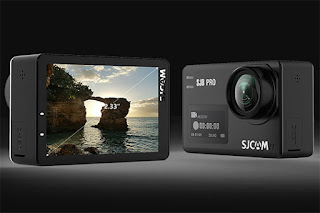
The SJCAM SJ8 Pro is featured with the Dual screen 2.33-inch touch screen (back) and 0.96-inch front screen. The front screen is able to show you the content like recording time, battery level, mode as well. The body of the camera is made of plastic and all the ports are covered. 
On the top of the camera, it has a power button to turn on and off the camera. As you turn On the camera shows all the options on the 2.33″ rear display which is touchscreen.
On the right side, it has the USB port C to charge the camera and at the bottom, you have the battery port. Overall the build quality is nice and impressive. The 12MP camera is able to shoot the videos at 4K@30fps and it has an 8X zoom as well.

Display

The double screen of the SJCAM SJ8 Pro outputs in better physical control and precise info display. With a back panel of 2.33 inch, the entire surface is logically covered so that you can operate the gadget in a tactile way. The touchscreen display is easy to control and also comes with two User Interface.
The tiny or LED panel of .96 inch completely showcases all the vital information in real time. The dimensions of the gadget are 2.46 x 1.61 x 1.13 inches with an overall weight is 70 gram for integration quality. The traditional external shell supports in-depth shooting experience within the water of up to 30meter.

Camera Sensor

The 12.0-megapixel sensor gives a huge competition to the Sony IMX377 digital camera. The high-quality camera gives appreciable image rate per second along with the high resolution. You can alter the overall settings to make the best use of 4K video Technology. The camera can also record the videos at 1080P@30fps, 15fps, 60fps, 50fps, 4K@30fps.
You can also capture the images at 4K, but here is a thing to use the 4K mode of the camera you need a bigger and batter memory card and personally I would suggest you use the class 10 Memory card.

Connectivity & Processor 

Apart from the very astounding sensor, the hardware configuration of the gadget is yet quite powerful. The ambarella H22 processor better than the umbrella H2 present in other models. When connected to Wi-Fi and Bluetooth, the device can exchange pictures at a maximum distance of 10M. It can also control through remote control and comes with image transmission to makes things very convenient. The USB-C port is also embedded within the gadget for exaggerated connectivity options.
The built-in microphone conveniently handles the voice commands whereas the GPS technology positions data speed and other operations.

Features

The SJCAM SJ8 pro comes with the IP68 waterproofing, so now pack your bag to go and shoot the videos and take photos of water up to 30m. The camera comes with multi modes which are Aerial Photography, Bike, Extreme Sports, Motorcycle, Ski, Underwater.
The SJCAM SJ8 Pro comes with a lot of mounting gears as Waterproof Housing with Mount and Screw, Frame, Base, Adhesive, Mount, Connector with Screw, Handle Bar Mount, Tripod Adapter and Tripod Mount Adapter, USB Cable.

Battery

The 1200 MH battery capacity gives 3 hours of standby time and 90 minutes of constant shooting and recording experience at 4K. Soon after you charge the device at 100% battery level, you can begin using it for sharp images and high-quality videos. It takes up to 2 hours for the device to get fully charged. You can also charge the battery through your power bank or smartphone.

SJCAM SJ8 Pro: Reviews & Conclusion

Although the features present in the SJCAM SJ8 Pro 4K are not as new as they could be, the reduction in price is huge. Besides, 2.33-inch touch screen is slightly out of the box when we compare the rest camera models floating in the market. Upgraded processor and powerful battery backup further make us happy to order the device from the leading E-commerce website like Gearbest.

Thursday, 22 March 2018

Zhiyun Crane Plus 3 Review

Zhiyun Crane Plus 3 Review

Zhiyun has again proven its capabilities in the Tech market. The world’s leading stabilizer designing company provides camera stabilizers, Gimbal with Ideal low cost. The perfect shooting experience empowered by a Zhiyun device let you grab pictures from all imaginable angles. The company is working hard to empower your shooting experiences by launching a whole new range of crane and stabilizers.
The ergonomically designed models buy Zhiyun are absolutely elegant and compact in look. The efficiency stimulation through Zhiyun stabilizers evacuates a series of problems that photographers faced till date. The invention of 360-degree panoramic shots with advanced slip ring Technology is one of the most commendable inventions of Zhiyun.


Tuesday, 30 January 2018

Xiaomi MiJia Mini 4K Action Camera Review

Xiaomi MiJia Mini 4K Action Camera Review


I don’t understand what Xiaomi’s strategy is here, allowing Mijia to create their own action camera when that has traditionally been the domain of Xiaoyi, Xiaomi’s dominant action camera arm. While this could present issues of cannibalization between both companies, its great for consumers such as us, more choice is never a bad thing.
The Mijia Camera Mini is a 699RMB ($106USD) action camera that is capable of shooting true 4K, making it instantly one of the cheapest 4K action camera options out there. Granted, those who live outside of China are faced with higher prices from resellers (around $115USD), but that still represents one steal of a deal, assuming Mijia gets this right.

Mijia Camera Mini Specifications

ProcessorAmbarella A12S75
Display2.4″ LCD 960×480
Lens7 Glass Lens
SensorSony IMX317
Recording Modes4K 30fps, 1080p 100fps, 720p 200fps
Aperturef2.8 aperture, 145 degree FOV
Battery1450mAh
Physical Dimensions7.15 x 4.27 x 2.95 cm, 99g
Big thanks to Gearbest for providing this review unit.

Mijia Camera Mini Hardware

The body of the camera is made out of sandstone, albeit smoother sandstone than what you find on the Oneplus One. It feels solid and doesn’t show smudges at all. However, I wonder how easy it would be to clean the sandstone if it got dirty. The front of the camera is made of soft rubber with the lens housing made out of metal, the Mijia is definitely one solid little bugger.
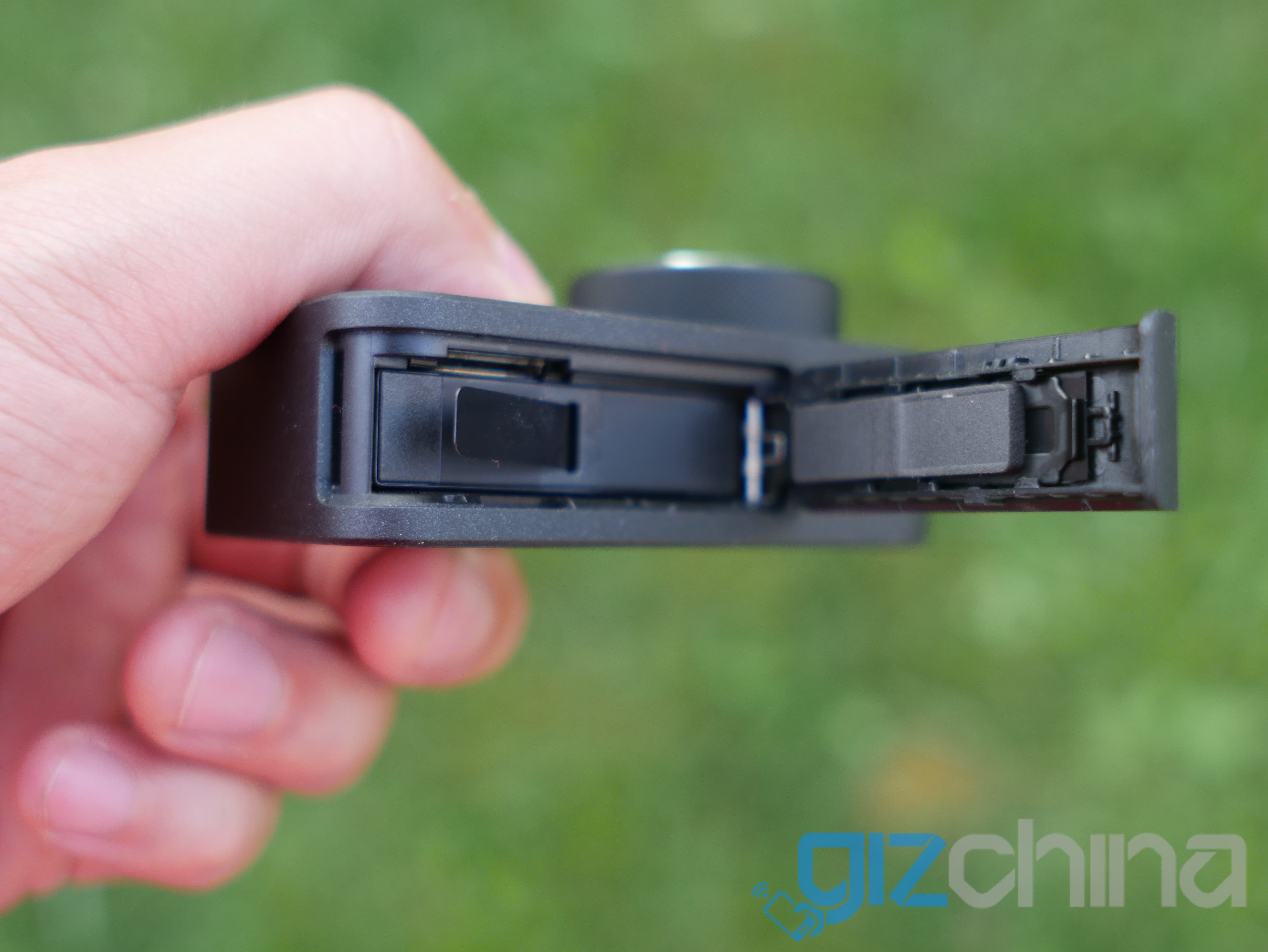
Apart from the build, the action cam is fairly minimalistic. There is an LED on the front, power/record button and mic on the top, and a microUSB port on the side that can be covered. On the bottom, the battery and MicroSD compartment. Do note that officially this action cam supports up to a 64GB microSD card, and mine does work, however I’m not sure if it supports 128GB/256GB microSD cards.
There is no waterproof case accompanying this camera and neither are there any official cases for purchase, meaning you have to wait before using it underwater or in rain.

Mijia Camera Mini Display

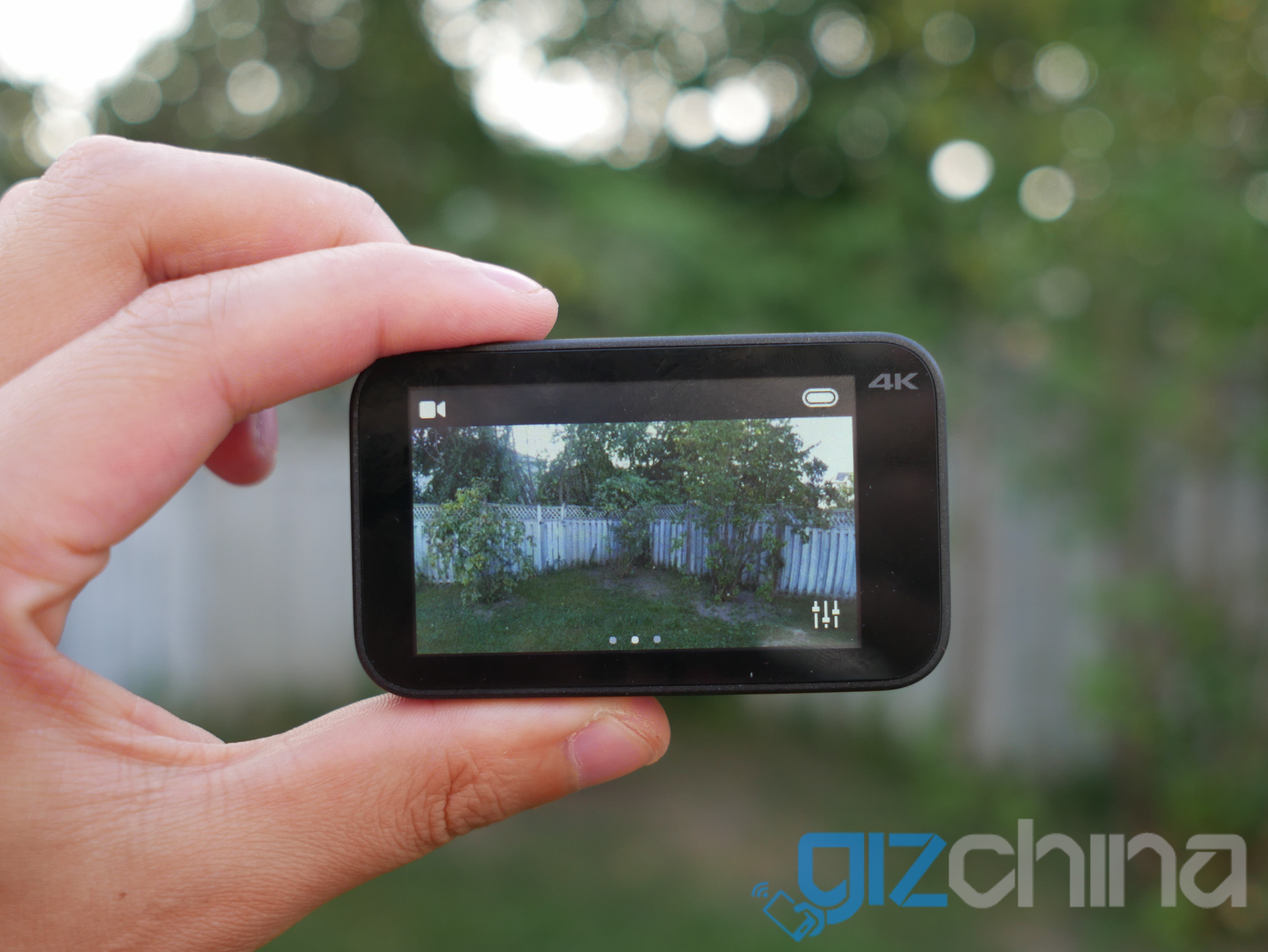
The display is a retina 2.4″ LCD with a resolution of 960×480, which works out to around 441ppi, definitely high enough to quality as a retina display. Quality wise the screen is nothing to write home about, colours are reproduced merely adequately and maximum brightness leaves much to be desired, especially in bright sunlight. The touchscreen itself is fairly responsive, so no complaints there.
Mijia Camera Mini Battery

The camera dies after one and a half hours of 4K recording and two hours of 1080p recording at 60fps, which is in line with what other action cameras such as Yi’s and GoPro’s offerings. Charging takes about an hour and a half.

Mijia Camera Mini Software & Performance

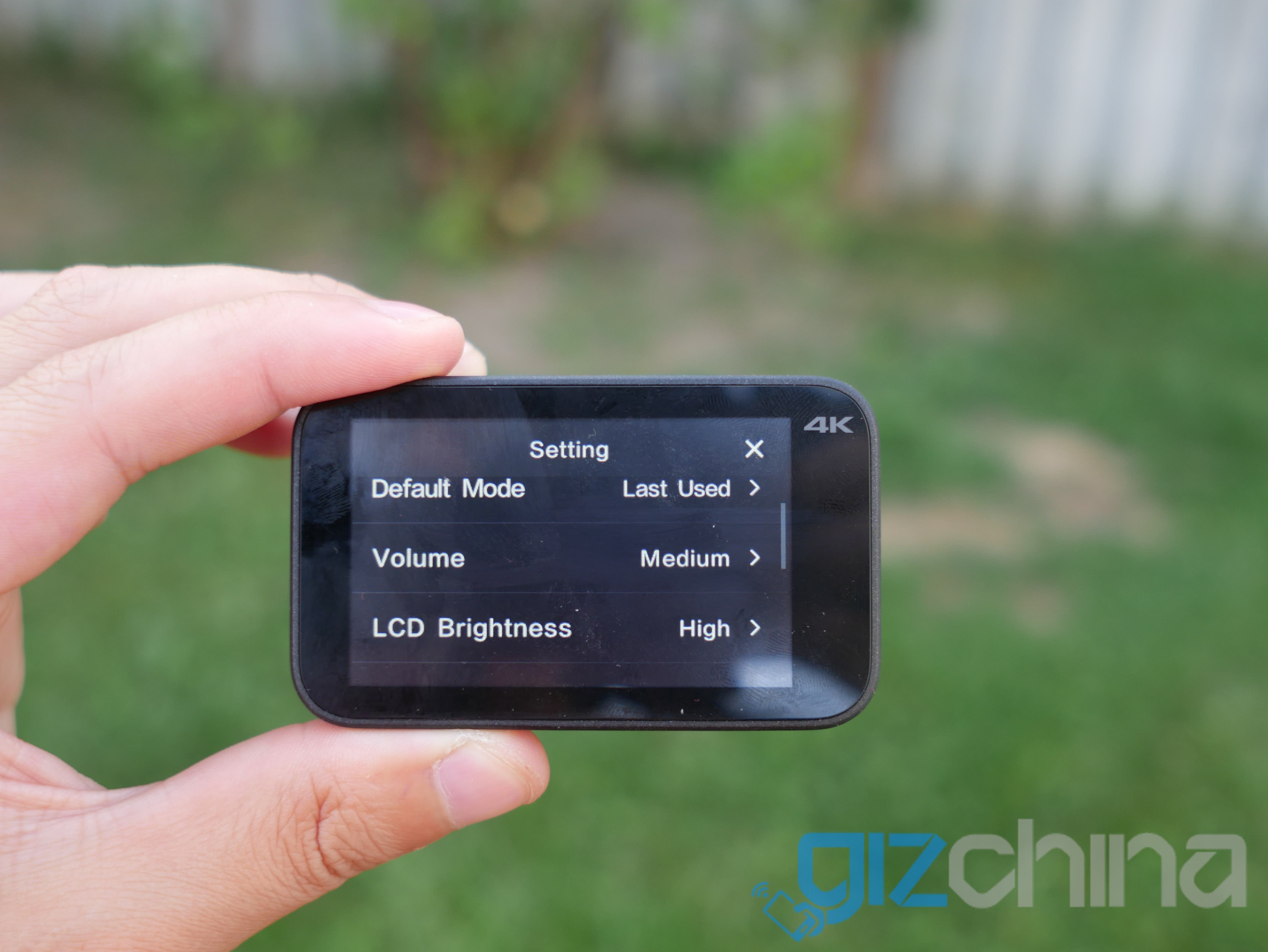
I wasn’t expecting English firmware on this device as it is an early unit, however I was very surprised to find the entire user interface in English. The interface works somewhat like a regular Android home screen, swipe left to access the gallery, swipe right to access video and photo options, and swipe down to access settings, WiFi and power options. The software is fairly well thought out, with many changeable settings such as EV, ISO, resolution etc. However, I could not find a setting for stabilization and am still searching for it as I did not see it anywhere.
Mijia has seen fit to use minimal animations on the action camera, something I dislike, as it makes the experience of navigating through the camera slow and stuttery.You can connect the camera to the phone using the Mi Home app, and it requires you to connect your phone to the camera’s WiFi before being presented with a simple user interface. You can remotely start and stop recordings, view photos and video, and change a few basic settings like resolution.

Mijia Camera Mini Camera Quality

On one hand, I’m surprised how crispy the 4K footage is for such a cheap action cam, and on the other hand I expected nothing less from Xiaomi (or Mijia in this case). Suffice it to say, You can take some fairly crispy 4K footage in good lighting, with lots of detail and good colour saturation. However, compare this to more expensive action cameras and you can definitely tell that the footage is slightly softer than those devices and the iPhone 7. The Mijia records at a bitrate of 60mbps, the same bitrate as the Xiaoyi Yi 4K Mirrorless camera and the GoPro Hero 5.
Auto brightness compensation works fairly well, I found the Mijia frequently overcompensating slightly for changes in lighting conditions, but it would adjust and recompensate correctly. There is also some barrel distortion from this 145 degree lens, as you can see in the picture below. Filming moving objects does work well also, with no perceived screen tear. There is electronic image stabilization that is accomplished by using a 3 axis gyroscope and 3 axis accelerometer, and unfortunately its just about enough to stabilize any microtremors in my hand but not enough for stabilizing large movements such as walking, running, or jumping.
Low light performance is poor, with plenty of noise and grain in videos and photos.
There is also slow motion, with 1080p framerates rising to an impressive and rather unconventional 100fps, 720p framerates rise to an equally impressive and unconventional 200fps. I do not recommend using 720p slowmo as too much detail is sacrificed, 1080p is the minimum resolution you should drop to.
Photo quality is fairly decent, with good colour saturation and decent amounts of detail, but there’s only so much you can do with an 8MP sensor.

Sunday, 24 December 2017

Thursday, 30 November 2017

Sony Alpha A7R III review

Sony Alpha A7R III review

Sony's megapixel monster gets a performance boost


OUR VERDICT

The Sony Alpha A7R III is not only the most well-rounded mirrorless camera you can buy today, but one of the best cameras out there right now.

FOR

  • 10fps at 42.2MP
  • Advanced 5-axis IS system
  • Large and bright EVF
  • Fast AF performance
  • Improved handling

AGAINST

  • Battery life could still be better
  • Limited touchscreen control
  • Only one SD slot supports UHS-II cards
The Alpha A7R III is Sony's latest high-resolution mirrorless camera, and an update of the excellent Alpha A7R II, which was responsible for tempting many a photographer away from the comfort of their Canon and Nikon DSLRs. 
This latest model looks to draw on many of the technologies used in the speed-orientated Sony Alpha A9, which is just as well, because with the likes of Nikon's brilliant D850 offering a tempting combination of high resolution and high performance the Alpha A7R II was beginning to look a little pedestrian. 
With some impressive boosts to performance, as well as tweaks to handling and the peace of mind of a five-year guarantee, could the new Alpha A7R III see even more second-hand Canon and Nikon DSLRs appearing on the shelves of camera stores as more photographers make the switch to Sony? 

Features

  • Full-frame stacked CMOS sensor, 42.2MP
  • 3,686K-dot electronic viewfinder with 100fps refresh rate
  • 3.0-inch tilt-angle screen, 1,440,000 dots
While many might have expected Sony to boost the amount of pixels to match or exceed DSLR rivals like the D850 and Canon EOS 5DS, it's actually opted to stick with the same count as the Alpha A7R II.
At the core of the A7R III then is a 42.2MP back-illuminated full-frame Exmor R CMOS sensor, although Sony has borrowed some of the innovations from the 24.2MP Alpha A9 and integrated them with this more densely populated chip. 
There are gapless microlenses and a new anti-flare coating for starters, while the Alpha A7R III features a new front-end LSI that almost doubles the readout speed of the sensor. It also takes advantage of the latest BIONZ X image processing engine, and combined, these enhancements deliver a boost of up to 1.8x in processing speeds compared to the A7R II.
Sony says the A7R III has a staggering 15-stop dynamic range at low sensitivity settings
The A7R III's sensitivity range remains unchanged (ISO50-102,400 at the camera's expanded setting), so those hoping for something to match the Nikon D850's expanded ISO32 setting may be a little disappointed. However, the new processing engine should be able to handle image noise better than its predecessor, while Sony also claims the Alpha A7R III will have a staggering 15-stop dynamic range at low sensitivity settings. 
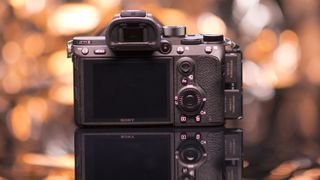
The Alpha A7R III has the same electronic viewfinder (EVF) as the Alpha A9, with the Quad-VGA OLED EVF sporting a resolution of approximately 3,686k dots, and utilizing a Zeiss T* Coating to reduce reflections. On top of this, the A7R III supports a customizable frame rate for the EVF, with options of either 60fps or 120fps, again matching the 120fps offered by the A9.
Image 1 of 4
Along with the EVF, the rear tilt-angle display has also been upgraded over the outgoing model; it now has a resolution of 1.44 million dots, and, just as we've seen with recent models like the RX10 IV, offers touchscreen functionality. 
Also as with the A9, Sony has shunned the XQD card format (even though it's now the sole manufacturer of that format), instead opting for dual SD card slots on the Alpha A7R III, with only one of those supporting UHS-II type cards.
The Alpha A7R III offers 4K (3840 x 2160 pixels) video capture, with the option to use either the full width of the sensor or Super 35mm format mode, with the latter using the full pixel readout without pixel binning to collect 5K of information, and oversampling this to produce what promises to be even crisper footage. 
As well as this, the Alpha A7R III now features a new HLG (Hybrid Log-Gamma) profile that supports an Instant HDR workflow, allowing HDR (HLG) compatible TVs to play back 4K HDR footage, while both S-Log2 and S-Log3 are also available. 
If you want to shoot Full HD footage you can capture this at up to 120fps, while there are ports for both a microphone and audio monitoring.

Wednesday, 29 November 2017

Canon PowerShot G1 X Mark III review

Canon PowerShot G1 X Mark III review


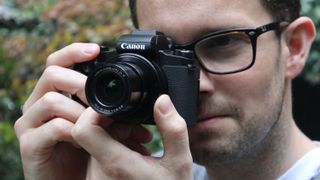
The Canon PowerShot G1 X Mark III is the latest in a long line of enthusiast-focused compact cameras, designed for photographers looking for something to complement their DSLR, or for those looking for a versatile alternative to a DSLR in a relatively compact body. 
The original PowerShot G1 was launched in 2000, and for a while that camera and its successors were the obvious choice when it came to choosing an enthusiast compact.
But with rivals like the RX100 series from Sony, the LX range from Panasonic and Fujifilm's X100 line, Canon's flagship PowerShot compact has struggled to stand out from the crowd in recent years. And it would be fair to say the outgoing G1 X Mark II, with its unique 1.5-inch sensor, missed the mark, so Canon is throwing everything at the G1 X Mark III.

Features

  • APS-C CMOS Sensor, 24.2MP
  • 3.0-inch vari-angle touchscreen, 1,040,000 dots
  • 1080p video capture
Where the G1 X Mark II used a 1.5-inch sensor, the G1 X Mark III uses a 24.2MP APS-C CMOS chip that's some 36% larger; it's nearly identical to the one in Canon's EOS 80D DSLR, delivering an ISO range from 100 to 25,600.
This is hooked up to Canon's latest DIGIC 7 image processor, allowing the PowerShot G1 X Mark III to not only handle data that much quicker than the older model, but promising to reduce the need to edit images thanks to an Auto Lighting Optimizer and Diffraction Correction.
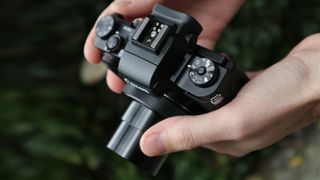
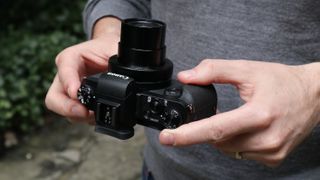
The G1 X Mark III sports a slightly more modest zoom range than the older model, at 24-72mm compared to 24-120mm, and has a f/2.8-5.6 aperture range. It also offers a close-focusing distance of just 10cm, while the lens features a nine-bladed aperture, which Canon says will produce pleasing background blur.
To minimize blur caused by camera shake, the PowerShot G1 X Mark III features a dual-sensing image stabilization system that can compensate for movement by up to four stops.
There's also five-axis Advanced Dynamic IS for video recording. While we're touching on video, the PowerShot G1 X Mark III can shoot 1080p video at up to 60p – there's no 4K video capture here. 
The PowerShot G1 X Mark III also gets a panoramic sweep mode, allowing you to capture a 67MP image (24,064 x 2800 for horizontal shots, 16,000 x 4200 for vertical images), with the camera automatically stitching the panorama as you pan the camera.
Image 1 of 4
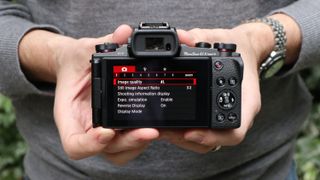
The PowerShot G1 X Mark III features a built-in EVF – something that was missing from the Mark II – with a 2.36 million dot 0.39x Organic EL display, while there's a 3.0-inch vari-angle touchscreen display with a resolution of 1.04 million dots, identical to the screens on the latest EOS DSLRs, such as the EOS Rebel T7i / 800D.
There's Wi-Fi, NFC and always-on Bluetooth connectivity to enable you to remotely transfer images from your camera to a compatible smart device. Canon's Camera Connect app also lets you wake the camera from its slumber (provided you haven't turned the camera fully off), as well as browse photos and operate the camera remotely.